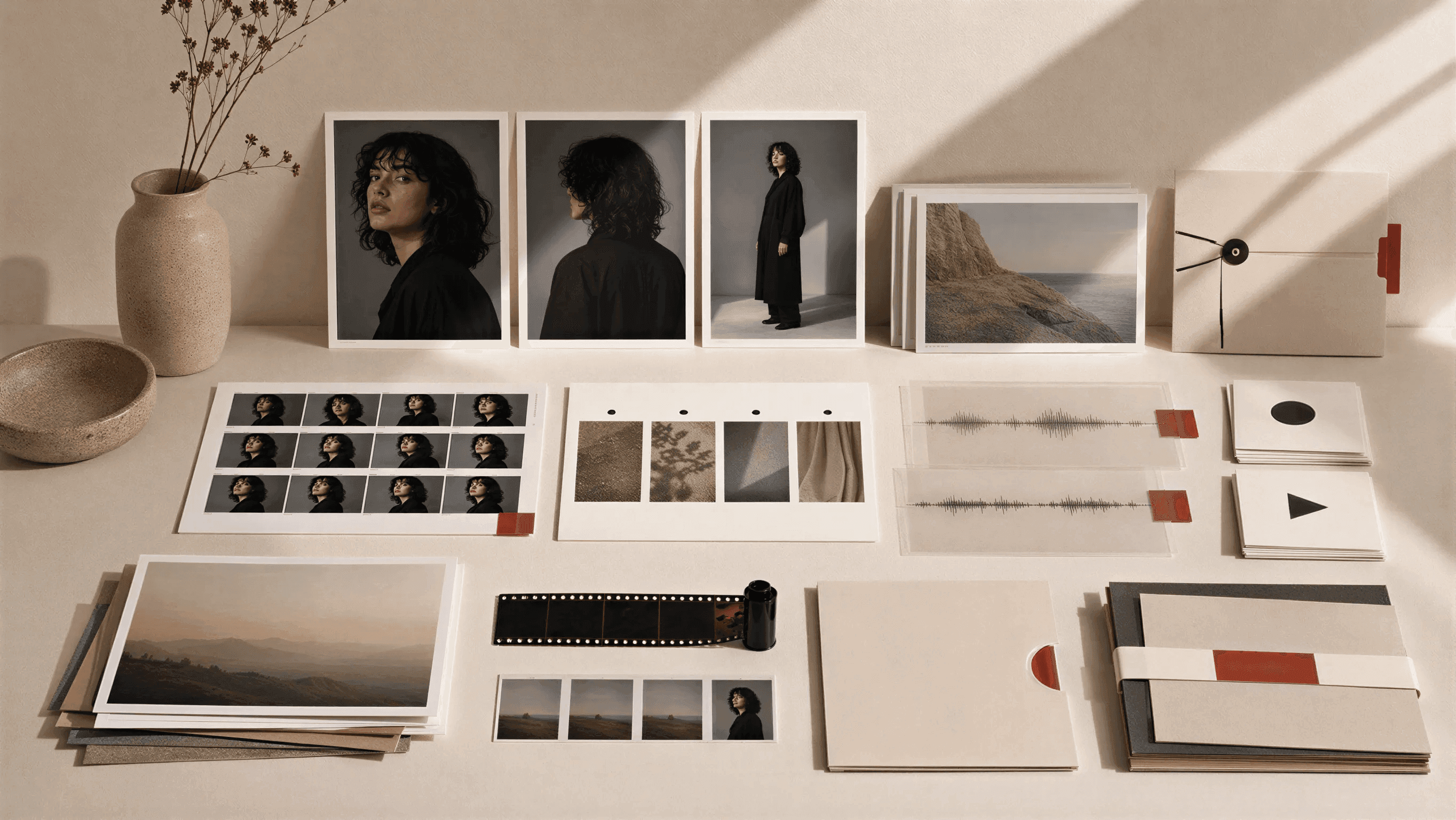
To animate a Midjourney character without losing the look, lock the identity in one clean still and let the video prompt describe motion—not the whole character again. My rule is simple: the still does the identity work; the prompt does the movement work.
If a face, hand, or outfit detail is already unclear in the still, I fix the image before animation. A longer motion prompt rarely rescues missing visual information; it usually gives the generator more ways to reinterpret it.
Why Midjourney characters drift the moment they move
Midjourney is very good at a specific thing: producing a style-locked still with a face, a palette, and a rendering style you actually want. The problem starts at the handoff.
Most creators lose the look because they describe the character again when they animate — “anime girl, silver hair, red jacket, walking.” The video model now has two sources of truth: your image and your words. It blends them, and the face shifts.
Drift often starts at the handoff: a new text description can conflict with details already encoded in the still. Treat the reference image as the identity and style source, and reserve the video prompt for motion and camera direction.
Can Midjourney animate its own images?
Midjourney starts each video at 5 seconds. You can extend it four times in 4-second increments, for a maximum length of 21 seconds. It supports Low Motion, High Motion, optional motion prompts, loops, and a different ending frame. Standard output is 480p; Standard, Pro, and Mega plans can generate 720p in Fast Mode.
It is genuinely good at ambient motion: drifting hair, a slow push-in, cloth movement, atmosphere.
Where it stops is character work. There's no lip sync and no native audio, so a character can't speak or sing. You can't hand it a reference performance and have your character copy that motion. And control over what moves is limited — a common creator complaint is that it animates mouths and faces that were supposed to stay still.
So the honest read: if you want a still to breathe, Midjourney's Animate is often enough. If you want a character to act, you need a video stack that takes an image as the source of truth. That's the workflow below.
Lock the look before you animate anything
Do not animate your first good image. Animate your cleanest image.
A reference still that survives animation usually has a clearly readable face, an unambiguous outfit, even lighting, and no cropped limbs. Motion models extrapolate from what they can see — anything ambiguous in the still becomes an invention in the video.
Fix problems while they're still cheap to fix. Inside DomoAI's Multi-Model Image Generator & Editor you can clean up the Midjourney still before spending a single video credit — repair hands, fix text on clothing, adjust an outfit detail, or flatten a busy background. Three model choices sit inside it: GPT Image 2 for precise control and clean typography, Nano Banana 2 for fast everyday edits, and Nano Banana Pro for character consistency work, which accepts up to nine reference images in a session and outputs at 4K.
Giving Nano Banana Pro multiple references can provide more visual context when you need a second pose or angle. Review the result against the approved character before animating it.
Save every keeper to Assets. You'll reuse these stills across shots, and you won't have to re-upload them.
Pick the animation route that matches the shot
There isn't one “Midjourney to video” button, because there isn't one job. Three routes cover almost everything, and picking the wrong one is the second-biggest cause of drift.
Route 1 — one strong still becomes a moving shot
Use Image to Video. This is the default for a character reveal, a mood shot, a camera push, or a hero frame from Midjourney.
DomoAI offers Seedance 2.0 as an Image to Video model, with 4–15-second output, 480P/720P/1080P settings, cinematic motion, native audio, and multi-shot support. DomoAI 2.4.1 Advanced and Fast are also available for lifelike motion and visual consistency in 5- or 10-second clips.
Practical advice: draft on a Fast model at low resolution until the motion is right, then re-run the winner at 1080P. Character shots often take several rolls, and there's no reason to pay full price for the rejects.
Route 2 — the start and the end of the shot both matter
Use Frames to Video. This is for transitions and transformations: closed eyes to open, civilian to costume, before to after.
Two modes, and the difference is real. With Seedance 2.0 / Seedance 2.0 Fast, you supply a start frame and an end frame only — the model fills the middle. With DomoAI 2.4.1, you can supply 2–8 keyframes with per-segment motion prompts and generate 1s–56s, which is what you want when you've storyboarded a sequence in Midjourney and need the video to hit each frame.
Midjourney can also animate from a starting frame to a different ending frame. Use that for a Midjourney-native transition up to 21 seconds. Use DomoAI Frames to Video when you need Seedance start/end control or DomoAI 2.4.1’s 2–8 keyframes, per-segment prompts, and 1–56-second workflow.
Route 3 — your character performs someone else's motion
Use Character to Video. This is the one Midjourney simply cannot do, and it's the reason most character creators end up with a second tool.
Feed it a reference video and your Midjourney character image. It replaces the character while preserving the original movement exactly. A dance clip, a walk cycle, a gesture — your character now performs it. Subject Only mode swaps the character while leaving the rest of the scene closer to the original.
Seedance 2.0 modes run 4s–15s; DomoAI 2.4.1 goes up to 30s per generation. Your character image can be JPEG, PNG, or JPG up to 10MB; the reference video can be MP4, MOV, or AVI.
This is the anime and VTuber workflow in one step: an OC still from Midjourney, a dance reference, and your character is dancing without you animating a single frame.
Build an Identity Lock Card Before Motion
I save a tiny identity card beside the source image. It is not another giant prompt. It is a short list of details I can check at the start, middle, and end of every clip.
| Lock | What to record | Reject the clip when |
|---|---|---|
| Face | Eye color, face shape, hairline, signature feature | Two or more features change |
| Outfit | Jacket shape, trim color, accessories | A key detail disappears or swaps sides |
| Silhouette | Hair length, shoulder width, skirt or coat outline | The body outline changes during the main action |
| Shot | Crop, lens feel, camera height, light direction | The framing breaks continuity with the previous shot |
| Motion budget | One subject action + one camera move + one atmosphere cue | The clip invents extra actions that hide identity |
If two source-image checks already fail, I go back to the Multi-Model Image Generator & Editor. For anime sources, the Niji 7 animation guide helps separate image-design choices from motion choices. For a longer sequence, I use the character-consistency workflow and plan the scene with the AI storyboarding guide.
A prompt you can copy for the first shot
The prompt describes motion and camera. It does not describe the character — the image already did that.
Subject holds position, slow breathing, hair moves gently. Camera slowly pushes in, shallow depth of field. Soft rim light, dust particles in the air. No change to face, outfit, or hairstyle.
Note the last line. Stating what must not change is unglamorous and it works. Add camera direction in time segments when you want tighter control — CAM 1 (0-3s): slow push in — or hit AI Optimize to expand a thin prompt into something the model can actually use.
When the look still breaks: fixes that work
The face changes halfway through. Your clip is too long for the amount of information in the still. Shorten it. Two clean 5-second clips cut together beat one drifting 15-second take, and this is the single most common fix.
The outfit invents details. The still was ambiguous there. Go back to image editing, make the detail explicit, re-animate. Do not try to prompt your way around a vague source image.
The character moves when it shouldn't. Add the explicit hold to your prompt — “no change to face, outfit, or hairstyle” — and drop to a lower-motion framing.
The style flattens. Midjourney's rendering is part of the character. If a route is washing it out, reduce the motion you're asking for; large motion forces more reinvention, and reinvention is where style goes.
Everything drifts, every time. Your reference still is the problem, not the model. Crops, extreme angles, and heavy shadow all starve the model. Re-generate a cleaner, flatter, fuller reference and try again.
Make the character speak or sing
Midjourney's video has no lip sync, so this step always leaves the platform.
Talking Avatar takes your Midjourney character image plus audio — either DomoAI's text-to-speech output or an uploaded MP3/WAV — and produces a speaking or singing character. Standard durations run 5s/10s/20s, with 30s and 60s fast mode on the Pro plan. You can direct expression separately from the script, so “smile” or “nod” doesn't have to be smuggled into the dialogue.
For AI singers, split a long vocal into shorter segments. Reviewing and replacing a bad 15-second take is much cheaper than re-running a full song.
One honest limitation: background music and full-song mixing aren't done here. Export the clip and lay the track under it in CapCut, Premiere Pro, or DaVinci Resolve.
Finish the clip
Generation runs at up to 1080P. For delivery, run the final cut through Video Upscaler for up to 4K.
Sequence matters: upscale the take you're keeping, not every draft. And if you're iterating heavily, Relax Mode on the Standard plan and up generates eligible outputs without spending credits — slower, but character work is a numbers game and this is where the numbers get affordable. Details are on the pricing page.
FAQ
Can I use Midjourney images in AI video tools commercially?
Midjourney says subscribers generally own the images and videos they create, subject to its terms and exceptions. Businesses with more than $1 million in annual gross revenue need a Pro or Mega plan for commercial use. DomoAI grants commercial rights on paid-plan output. Check both current terms before client publication.
Why does my character look different in every shot?
You're describing the character in the prompt instead of letting the image carry it. Animate from one locked reference still and restrict the prompt to motion only.
Is Midjourney's own video model good enough?
For ambient motion on a single still, often yes. For lip sync, motion transfer from a reference performance, or clips beyond its extend limit, you'll need a dedicated video stack.
What's the longest clip I can generate from one Midjourney still?
Midjourney starts at 5 seconds and supports four 4-second extensions, for a 21-second maximum. In DomoAI, one-still Image to Video with Seedance 2.0 runs 4–15 seconds. Longer Frames to Video and Character to Video workflows use additional inputs and solve different jobs.
Do I need to re-upload my image for every tool?
No. Save stills to Assets once, then drag them from the History panel straight into whichever tool you're using next.
Start with one still
Take your best Midjourney character — the one whose look you've been protecting — and give it one clean edit, then one 5-second animation. Not a whole music video. One shot.
If the face holds, the workflow holds, and everything above is just scale.
Animate your Midjourney character with DomoAI →